Highlights
|
Background and objective
Cross-sectional studies have shown lower muscle mass and strength as risk factors for nonalcoholic fatty liver disease (NAFLD). However, evidence from prospective studies is limited.
This study examined both the strength and pattern of associations between these two markers of physical capacity and severe NAFLD in the UK Biobank study.
Methods
333,295 participants were included in this prospective study. Grip strength was measured using a Jamar J00105 hydraulic hand dynamometer, and the Janssen equation was used to estimate skeletal muscle mass by bioimpedance.
Muscle mass was adjusted for body weight and all exposures were standardized by sex. Associations of muscle mass and strength with severe NAFLD (defined as hospital admission or death) were first investigated by tertile of each exposure using Cox proportional hazards models.
Nonlinear associations were investigated using penalized cubic splines fitted in Cox proportional hazards models.
Results
After a median follow-up of 10 years (IQR: 9.3 to 10.7 years), 3,311 people were diagnosed with severe NAFLD (3,277 hospitalizations and 34 deaths).
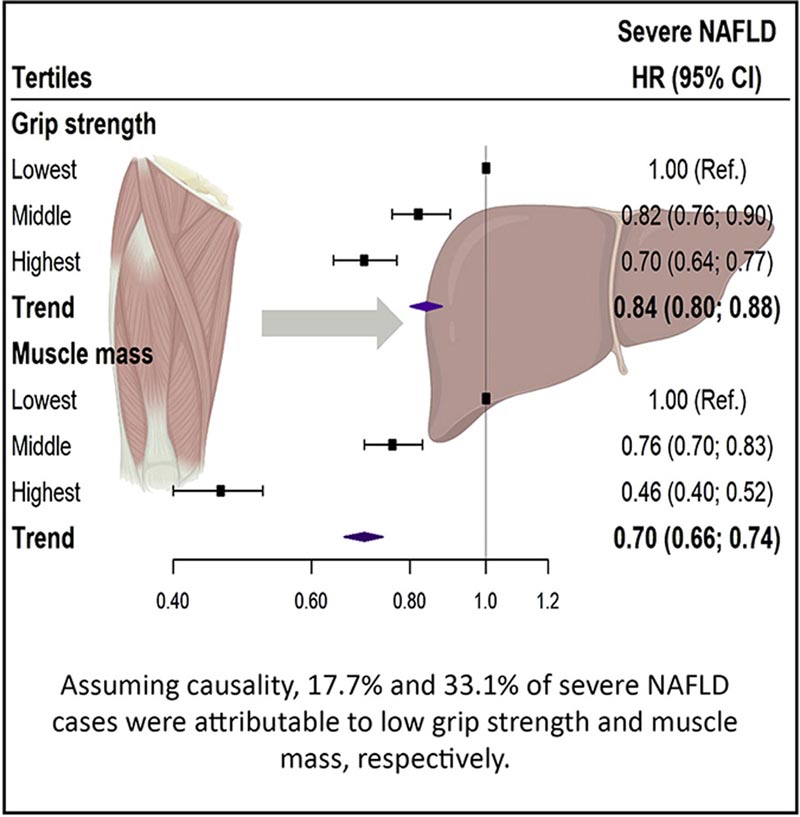
Compared with the lowest tertile of muscle mass, the risk of NAFLD was lowest in the middle (HR: 0.76 [95% CI: 0.70 to 0.83] and the highest tertile (HR: 0.76 [95% CI: 0.70 to 0.83]). 46 [95% CI: 0.40 to 0.52]).
Grip strength tertiles showed a similar pattern, nonlinearity was only identified for muscle mass (p<0.001), a lower tertile of grip strength and muscle mass represented 17.7%% and 33.1%. % of severe cases diagnosed, respectively.
Conclusions
|