Summary Background Initial orthostatic hypotension (IOH) is a form of orthostatic intolerance defined by a transient decrease in blood pressure upon standing. Current clinical recommendations to manage OIH include standing slowly or tensing the lower body muscles (TENSE) after standing. Considering that HIO is likely due to a large muscle activation response resulting in excessive vasodilation with a refractory period (<2 minutes), we hypothesized that preactivation of lower body muscles ( PREACT) before standing would reduce the drop in mean arterial pressure (MAP) upon standing and improve the symptoms of presyncope. Aim The purpose of this study was to provide patients with HIO with effective symptom management techniques. Methods Study participants completed 3 sit-to-stand maneuvers, including a no-intervention stop (Control), PREACT, and TENSE. Continuous heart rate and blood pressure were measured beat by beat. Stroke volume and cardiac output were then estimated from these waveforms. Results A total of 24 female IOH participants (mean ± SD: 32 ± 8 years) completed the study. Drops in MAP after PREACT (–21 ± 8 mm Hg; P < 0.001) and TENSE (–18 ± 10 mm Hg; P < 0.001) were significantly reduced compared to Control (–28 ± 10 mm Hg). The increase in cardiac output was significantly greater after PREACT (2.6 ± 1 L/min; p < 0.001) but not TENSE (1.9 ± 1 L/min; p = 0.2) compared to control (1.4 ± 1 l/min) . Vanderbilt Orthostatic Symptom Score after PREACT (9 ± 8 au; p = 0.033) and TENSE (8 ± 8 au; p = 0.046) were significantly reduced compared to control (14 ± 9 au). Conclusion Both MAP drop and standing symptoms improved with PREACT or TENSE. These maneuvers provide new symptom management techniques for patients with HIO. |
Comments
Two non-drug treatments can improve a patient’s quality of life, scientists report in a novel study published in Heart Rhythm .
Feeling dizzy upon standing due to initial orthostatic hypotension (OIH), or a transient decrease in blood pressure and increase in heart rate, is a common but poorly understood condition.
A new study offers two simple, no-cost, drug-free techniques to effectively manage HIO symptoms and improve quality of life by activating lower body muscles before or after standing.
The research appears in Heart Rhythm , the official journal of the Heart Rhythm Society, Cardiac Electrophysiology Society, and Pediatric & Congenital Electrophysiology Society, published by Elsevier.
Syncope, lightheadedness, dizziness, or loss of consciousness due to OIH affect up to 40% of the general population (all ages), while presyncope is probably even more common.
Despite this, the condition is relatively understudied and minimal information is available on the underlying mechanisms or management and treatment of symptoms. Currently, there are very few options available for patients with HIO and without pharmacological treatments. The most common recommendations have been to get up slowly or sit first before standing.
"Almost everyone has probably experienced dizziness at some point after standing up," explained lead researcher Satish R. Raj, MD, MSCI, FHRS, professor of cardiac sciences, Libin Cardiovascular Institute, Cumming School of Medicine, University of Calgary, Calgary, AB, Canada.
“For some people, this occurs frequently and can occur several times a day, which can be very frightening and negatively impact their quality of life. "We wanted to explore this further and provide novel and effective symptom management techniques with the goal of improving the quality of life of the IOH patient."
This study investigated physical maneuvers before or after standing and their effectiveness in reducing the drop in blood pressure as well as the symptoms typically seen in patients with OIH upon standing.
Study participants included 24 young women (mean age 32 ± 8 years) with a high burden history of fainting immediately after standing and more than four episodes of presyncope or syncope per month.
Study participants were required to have a significant drop in systolic blood pressure of at least 40 mmHg upon standing to meet diagnostic criteria for IOH on the study day. Two participants had inadequate heart rate recordings and were excluded from the analysis.
The 22 study participants completed three sit-to-stand maneuvers, including one no-intervention standing position (control) and two interventions.
Researchers found that both preactivation of the lower body muscles (thighs) through repeated knee raises before standing (PREACT) and tension of the lower body muscles (thighs and glutes) through through leg crossing and tension immediately after standing (TENSE) effectively improve the drop in blood pressure.
This led to a reduction in symptoms upon standing. They found that the PREACT maneuver accomplished this by increasing cardiac output, while the TENSE maneuver accomplished this by increasing stroke volume.
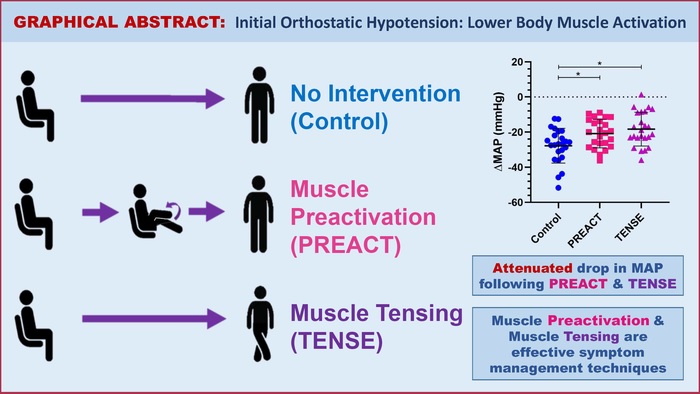
Image: Researchers determined that both preactivation of the lower body muscles (PREACT) and tension of the lower body muscles (TENSE) effectively reduced the drop in mean arterial pressure during standing and Symptoms of initial orthostatic hypotension improved.Left: Schematic diagram of the three interventions: no intervention (Control), PREACT and TENSE. Right: decrease in mean arterial pressure after Control (blue), PREACT (pink), and TENSE (purple).
"Our study provides a novel and free symptom management technique that patients with HIO can use to manage their symptoms," said first author Nasia A. Sheikh, MSc, Libin Cardiovascular Institute, Cumming School of Medicine, University of Calgary, Calgary, AB, Canada.
“Since it is a physical maneuver, it simply requires the lower extremities of the body, which patients can use at any time and from anywhere to combat their symptoms.”
“Our study demonstrates the physiology of IOH and evaluates the usefulness of physical maneuvers that can help the patient with IOH control their symptoms. “Patients identify a diagnosis of HIO as the critical first step in empowering them to understand and master their symptoms and therefore minimize the disruptions to daily life caused by this common, but not commonly understood, condition,” added co-investigator Mary Runté. , PhD, University of Lethbridge, Lethbridge, AB, Canada.
In an accompanying editorial, Bert Vandenberk, MD, PhD, Department of Cardiac Sciences, Libin Cardiovascular Institute, Cumming School of Medicine, University of Calgary, Calgary, AB, Canada;and Department of Cardiovascular Sciences, KU Leuven, Leuven, Belgium; and Carlos A. Morillo, MD, FHRS, Department of Cardiac Sciences, Libin Cardiovascular Institute, Cumming School of Medicine, University of Calgary, Calgary, AB, Canada, commented that “PREACT and TENSE provide an effective, simple symptom relief option. and elegant for patients with HIO.”
However, they noted: “The study needs to be validated in men, in addition to being explored in the elderly, where multiple confounding factors must be addressed. “Understanding the role of cardiopulmonary mechanoreceptors should also provide more insight into the mechanisms of the effects of these simple but very effective physiological maneuvers.”